Publications

Climate Change Adaptation

20 October 2015 - ClimasCOPe - By : Vivian DEPOUES, PhD

Heading towards the 2015 Paris international Climate Conference (COP21), I4CE, in partnership with ADEME, the French Environment and Energy Management Agency, releases ClimasCOPe # 5 on climate change adaptation

ClimasCOPe # 5 focuses on the place of climate change adaptation in the climate action. After an editorial titled « COP 21: a new approach and the launch of a process to address climate change adaptation » written by A. Leseur and V. Dépoues, I4CE experts analyze the issue of adapting to climate change by taking ownership of the issues and removing barriers to implementations. Then, ClimasCOPe #5 presents the recent developments of in international climate negotiations (the climate negotiations before the COP21, a new Sustainable Development Agenda for 2015-2030, New York Climate week, ministerial meetings and the annual meetings of the World Bank and IMF); to end it up with four key initiatives related to climate change adaptation.
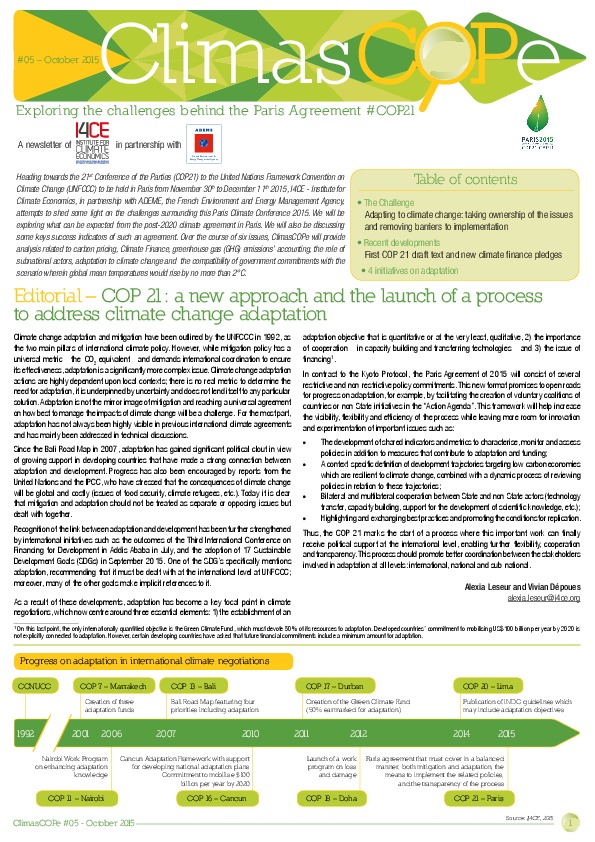

Climate Change Adaptation Download
See appendices
  • CLIMASCOPE #5 – la adaptación al cambio climático Download
I4CE Contacts
Vivian DEPOUES, PhD
Vivian DEPOUES, PhD
Research Lead – Adaptation to climate change Email
To learn more
  • 01/16/2026 Foreword of the week
    2026: An electric atmosphere

    The year ahead promises to be electric. In a highly unpredictable geopolitical context, the European Union must balance its commitment to the long-term goals of climate neutrality and the immediate attention to security and competitiveness concerns. This puts electrification high on the agenda in Brussels. First, the Grids Package, presented in December 2025, provides for a more centralised approach to planning and is expected to be adopted by the Council in June. Second, before the summer, the Commission intends to present an Electrification Action Plan, which will focus on lowering prices and reinforcing demand. 

  • 12/12/2025 Blog post Foreword of the week
    Paris +10: France and Europe must step up on climate – to protect our security, sovereignty, competitiveness, and public finances

    How distant December 12, 2015 now seems. All delegations at COP21 had then rallied behind Laurent Fabius’s little green hammer. Ten years later, the trend is closer to backlash. Climate action is now often portrayed in the public debate as too costly, because it requires major investment. Ineffective, since our share of global emissions is small. Unfair, because it cuts into purchasing power. Too divisive, supported only by part of the electorate. Too late, since keeping the planet below +2°C of warming now seems out of reach. Arguments that are partly true—yet require substantial nuance. 

  • 12/11/2025 Blog post
    Climate finance at COP30: Progress, pitfalls, persistent challenges and the path ahead

    A few weeks ago, COP30 concluded in Belém with all parties agreeing on a “global mobilization” (or mutirão) against climate change, proving that multilateralism remains a viable path for action, despite strong geopolitical and economic headwinds. However, Belém delivered underwhelming results: no roadmap to transition away from fossil fuels –despite a powerful push from President Lula, rallying over 80 countries, a lack of concrete decisions on deforestation –disappointing for an “Amazon COP”, and mixed results on the global goal on adaptation, among other outcomes.  

See all publications
Press contact Amélie FRITZ Head of Communication and press relations Email
Subscribe to our mailing list :
I register !
Subscribe to our newsletter
Once a week, receive all the information on climate economics
I register !
Fermer