Publications

Financing the low-carbon transition

20 May 2015 - By : Ian COCHRAN, Phd / Hadrien HAINAUT

Heading towards the 2015 Paris international Climate Conference (COP21), CDC Climat Research, in partnership with ADEME, the French Environment and Energy Management Agency, publishes a ClimasCOPe # 2 aiming to shed some light on the challenges of international climate negotiations.

ClimasCOPe # 2 is focused on the financing of the low-carbon transition. After an editorial titled « Financing the low-carbon transition : the need for coherence between regulations and ambition », CDC Climat Research experts analyze the issue of financing as a cornerstone in the Paris Climate 2015 agreement, last steps in international climate negotiations and key initiatives of Climate Finance developed in the world.
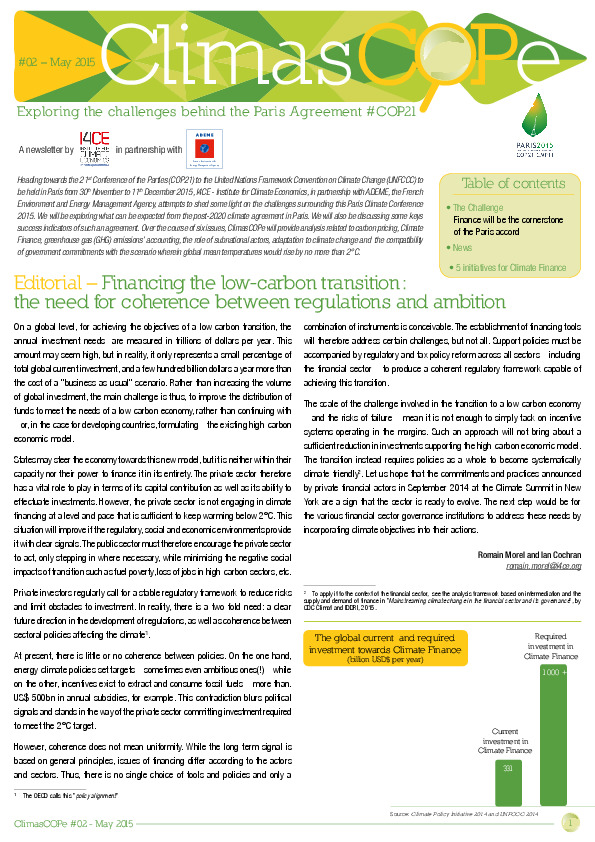

Financing the low-carbon transition Download
See appendices
  • CLIMASCOPE #2 – Financiar la transición hacia un modelo bajo en carbono Download
I4CE Contacts
Hadrien HAINAUT
Hadrien HAINAUT
Program director – Climate finance, energy transition and forecasting Email
To learn more
  • 12/05/2025 Foreword of the week
    Maintaining the 2035 target: Ensuring a viable future for Europe’s automotive industry

    In the run up to the publication of the European Commission’s proposals for an automotive package on 10 December, car manufactures have stepped up the calls to relax the CO2 standards and the 2035 phase-out of new combustion-engine vehicles by including some flexibilities. They highlight the challenges the industry has faced in recent years, growing competitive pressure from China, and insufficient demand for electric vehicles in Europe as reasons for the sector needing more time for the transition required to meet the targets.

  • 12/04/2025 Blog post
    Relaxing EU standards on CO2 emissions won’t save the EU’s automotive industry, or help consumers

    Recently, car manufacturers have been calling for a relaxation of CO2 emission standards for cars and vans and the 2035 phase-out target for new internal combustion engine (ICE) vehicles, by including some flexibilities. They point in particular to the crisis the industry has faced in recent years, growing competitive pressure from China, and insufficient demand for electric vehicles (EVs) in Europe, as reasons for the sector needing more time for the transition required to meet the targets. As the European Commission (EC) prepares to publish its package for the automotive industry, including a revision of CO₂ standards for cars and vans, this blogpost examines the realities behind the difficulties currently faced by car manufacturers and the consequences of relaxing and postponing the planned EU regulations for this sector. 

  • 12/04/2025 Blog post
    Maintaining the 2035 target to support the transition of the French automobile industry

    With the aim to reduce its CO2 emissions and costly fossil-fuel imports, in 2022 the European Parliament adopted a rule that, from 2035, all new vehicles must be zero-emission, which essentially means that they must be electric. However, this rule is now being questioned, with car manufacturers requesting that it be revised to allow plug-in […]

See all publications
Press contact Amélie FRITZ Head of Communication and press relations Email
Subscribe to our mailing list :
I register !
Subscribe to our newsletter
Once a week, receive all the information on climate economics
I register !
Fermer