Publications Development finance

Addressing challenges of physical climate risk analysis in financial institutions

2 February 2021 - Climate Report - By : Romain HUBERT / Iulia MARGINEAN / Michel CARDONA / Christa CLAPP / Jana SILLMANN

While the financial consequences of climate impacts are already materializing, the regulators are implementing their agenda of actions to stimulate financial institutions into analyzing and managing their exposure to “physical climate risks”, and disclosing how they do so as recommended by the TCFD. How can financial actors make quick and efficient progress on analyzing and managing these risks? 


I4CE and CICERO release a synthesis report of practical lessons from the ClimINVEST project: a 3-year collaboration between European climate experts and financial institutions to move forward with physical climate risk analysis and management. The project gathered ClimINVEST partners Carbone 4, Climate Adaptation Services, CICERO, I4CE, Météo France and Wageningen Environmental Research as well as a number of financial institutions in France, the Netherlands and Norway. The participating institutions in France included AFD, BPCE, la Caisse des Dépôts, HSBC, Natixis.


The project shed light on four major challenges that were partly mitigated during the project: the tragedy of time horizons; the black box of climate services; data accessibility; the quantification of financial impacts.


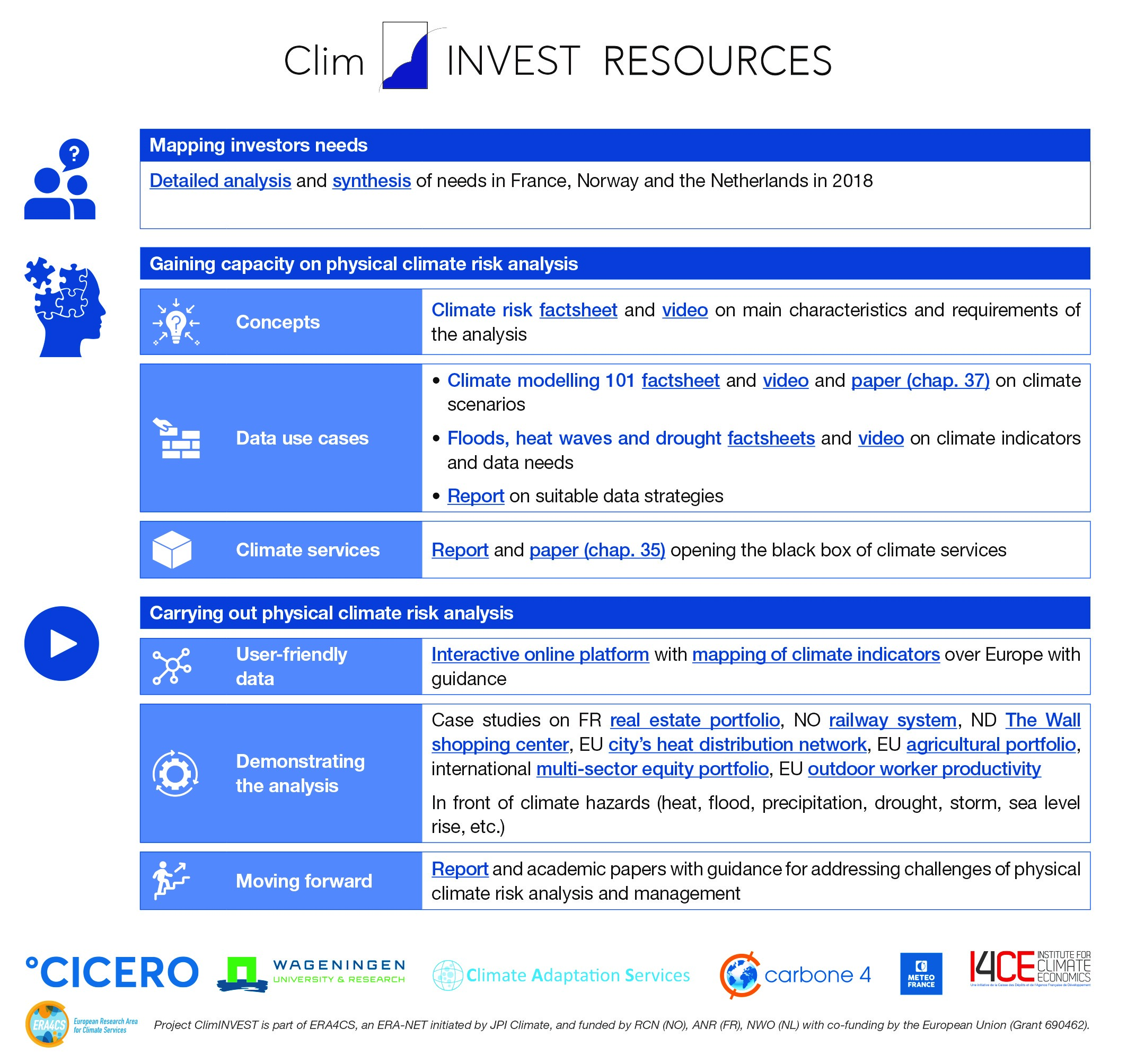
There is still much work to do though. The report summarizes priority action points based on feedbacks from twelve financial institutions involved in the project and from the research partners. Financial actors should build further expertise on physical climate risks and experiment climate risk assessment on their own portfolios. To do so, they can capitalize on the publicly available ClimINVEST resources listed on the figure below. Mobilizing not only financial actors but also a broader range of stakeholders will also be a key determinant for quick progress on physical climate risks in finance. Regulators, supervisors, scientists, service providers, municipalities, etc. all have a role to play.


Access the clickable links of the graphic 


Click on this button to see the image


Romain Hubert, Project Manager at I4CE, explains in two minutes what the physical climate risk is and the challenges faced by banks :



Addressing challenges of physical climate risk analysis in financial institutions Download
I4CE Contacts
Romain HUBERT
Romain HUBERT
Chercheur – Risques climat, Acteurs financiers et adaptation Email
Michel CARDONA
Michel CARDONA
Senior associate Expert – Financial Sector, Risks and Climate Change Email
To learn more
  • 12/11/2025 Blog post
    Climate finance at COP30: Progress, pitfalls, persistent challenges and the path ahead

    A few weeks ago, COP30 concluded in Belém with all parties agreeing on a “global mobilization” (or mutirão) against climate change, proving that multilateralism remains a viable path for action, despite strong geopolitical and economic headwinds. However, Belém delivered underwhelming results: no roadmap to transition away from fossil fuels –despite a powerful push from President Lula, rallying over 80 countries, a lack of concrete decisions on deforestation –disappointing for an “Amazon COP”, and mixed results on the global goal on adaptation, among other outcomes.  

  • 11/28/2025 Foreword of the week
    COP30: The missed turn to implementation – and the coalitions moving ahead anyway

    COP30 concluded with an agreement, proving that multilateralism is still alive. However, the results are underwhelming: no push to transition away from fossil fuels, no decision on deforestation, and mixed outcomes on adaptation metrics.  On climate finance, Belém failed to shift from ambition to implementation. Negotiations quickly drifted back to a battle on yet another high-level quantitative target. The decision to triple adaptation funding by 2035 disappointed many, with its distant time horizon, lack of baseline and non-binding wording. COP30 also missed the opportunity to engage with – and build consensus around – concrete measures outlined in the Baku to Belém roadmap to get to $1.3 trillion. Instead, it defaulted to launching new processes – a work programme on climate finance and a ministerial roundtable on the NCQG.  

  • 11/13/2025
    How solidarity levies can help bridge the climate and development finance gap

    The climate and development finance gap is large and widening, as Official Development Assistance (ODA) declines and needs multiply. With shrinking fiscal space in vulnerable countries, solidarity levies are gaining attention as a predictable source of international finance. Launched at COP28 by Barbados, France, and Kenya, the Global Solidarity Levies Task Force (GSLTF) is the main initiative in this space.

See all publications
Press contact Amélie FRITZ Head of Communication and press relations Email
Subscribe to our mailing list :
I register !
Subscribe to our newsletter
Once a week, receive all the information on climate economics
I register !
Fermer