Publications

What should we take away from Cancún?

24 January 2011 - Climate Brief - By : Marion Jeulin / Marion Jeulin

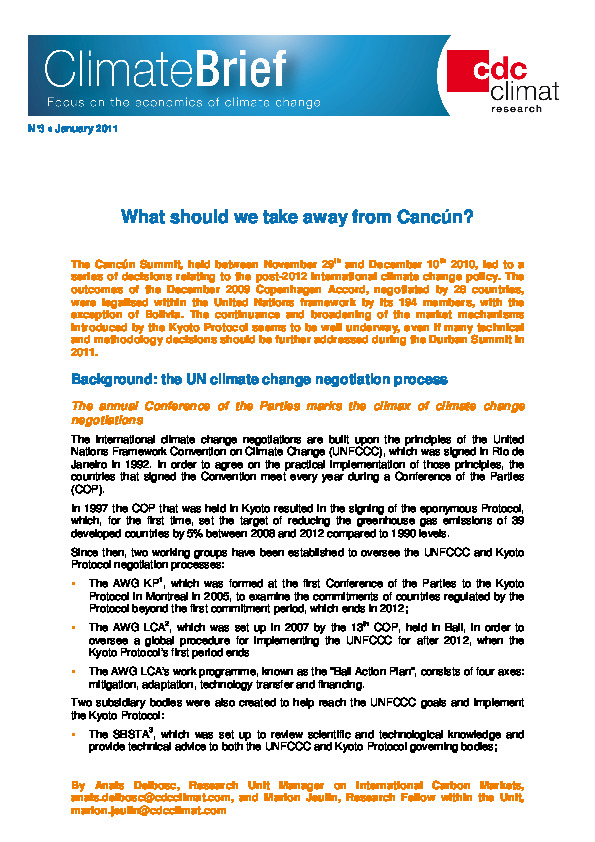
The Cancún  Summit, held between November 29thand December 10th 2010, led to a series of decisions relating to the post-2012 international climate change policy. The outcomes  of  the  December  2009  Copenhagen  Accord,  negotiated  by  28  countries, were  legalised  within  the  United  Nations  framework  by  its  194  members,  with  the exception  of  Bolivia.  The  continuance  and  broadening  of  the  market  mechanisms introduced by the Kyoto Protocol seems to be well underway, even if many technical and methodology decisions should be further addressed during the Durban Summit in 2011.
 

What should we take away from Cancún? Download
To learn more
  • 11/28/2025 Foreword of the week
    COP30: The missed turn to implementation – and the coalitions moving ahead anyway

    COP30 concluded with an agreement, proving that multilateralism is still alive. However, the results are underwhelming: no push to transition away from fossil fuels, no decision on deforestation, and mixed outcomes on adaptation metrics.  On climate finance, Belém failed to shift from ambition to implementation. Negotiations quickly drifted back to a battle on yet another high-level quantitative target. The decision to triple adaptation funding by 2035 disappointed many, with its distant time horizon, lack of baseline and non-binding wording. COP30 also missed the opportunity to engage with – and build consensus around – concrete measures outlined in the Baku to Belém roadmap to get to $1.3 trillion. Instead, it defaulted to launching new processes – a work programme on climate finance and a ministerial roundtable on the NCQG.  

  • 11/21/2025 Foreword of the week
    How to strengthen climate risk management and supervision to protect financial stability

    Climate change does not conform to business, political or supervisory regime cycles– its adverse long-term impacts lie beyond such horizons. Ten years ago, when Mark Carney highlighted this paradox in his landmark Tragedy of the Horizons speech, climate change was not considered a financial stability risk. Today, European supervisory stress tests estimate up to €638 billion in banking losses over 8 years, while the European Central Bank (ECB) reveals that over 90% of eurozone banks face climate and environmental risks. A key question arises: Is the supervisors’ primary focus on greening the financial system sufficient in the face of rising risks, especially stranded assets? 

  • 11/13/2025
    How solidarity levies can help bridge the climate and development finance gap

    The climate and development finance gap is large and widening, as Official Development Assistance (ODA) declines and needs multiply. With shrinking fiscal space in vulnerable countries, solidarity levies are gaining attention as a predictable source of international finance. Launched at COP28 by Barbados, France, and Kenya, the Global Solidarity Levies Task Force (GSLTF) is the main initiative in this space.

See all publications
Press contact Amélie FRITZ Head of Communication and press relations Email
Subscribe to our mailing list :
I register !
Subscribe to our newsletter
Once a week, receive all the information on climate economics
I register !
Fermer